
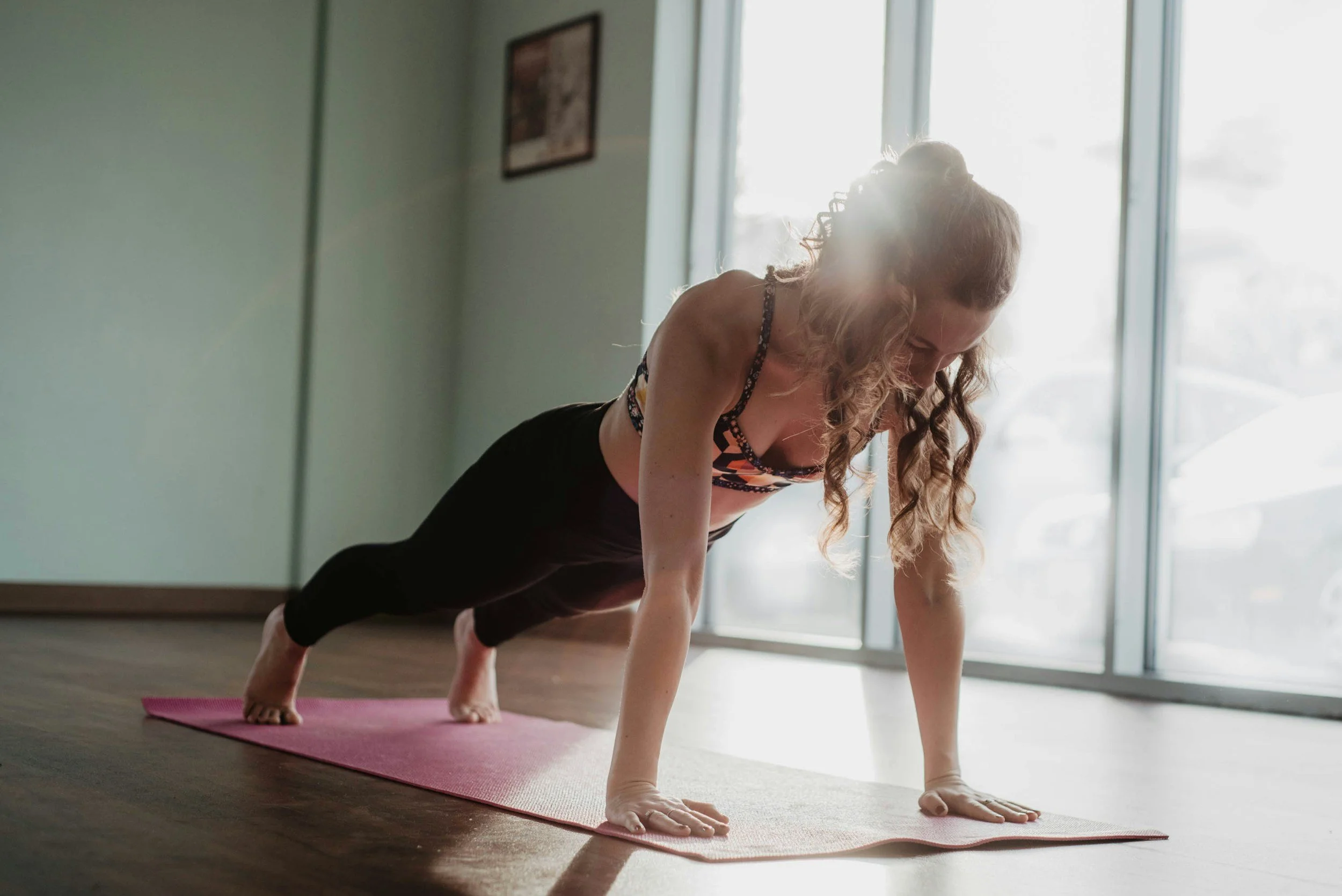
Here's the truth...
If you can already hold a plank for 2 minutes or longer,
you don't need to keep chasing a longer hold.
At that point,
you need to make the plank harder, not hold it for longer.
If you can't hold a plank for 2 minutes I'll show you:
How long you should be able to hold a plank for based on your age
The muscles a plank works and why it's a great exercise to do
The right way to do a plank so you work your abs not your hips
How to make the plank harder
Here’s how long you should be able to hold a plank below.
How long you should be able to hold a plank according to your age
The goal according to your age should be:
30–60 seconds: Master perfect technique.
60–120 seconds: Build endurance.
120+ seconds: Make the exercises harder
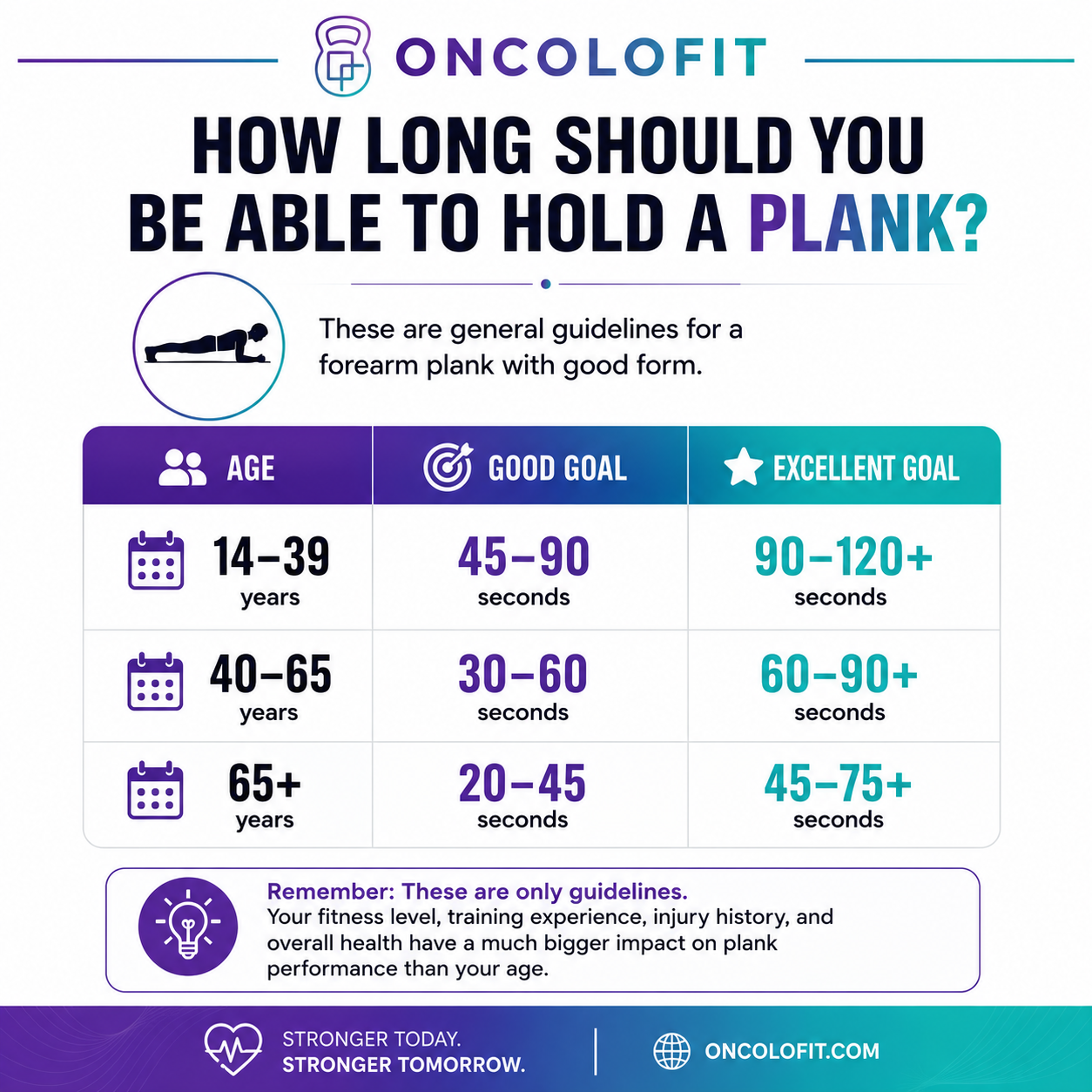
Your age doesn’t stop you from acheiving your goals but… it does change where you are starting from.
My online coaching client is 67 and in remission from breast cancer started doing a plank by holding it for 20s… and in 3 months she was able to reached 2 minutes of a plank!
And now she is doing much harder variations.
stronger plank means less pain
The longer you sit the more you put your core, hips, glutes, and back in a weak position.
And the weaker the position,
The more pain this can cause in the long term.
So a plank is an “anti- sitting position” that forces your body to strengthen muscles sitting weakens.
It strengthes your:
glutes
hip flexors
obliques (the sides)
rectus abdominis (the front of your abs)
transverse abdominis (deep core that wraps around your waist)
Each muscle is essential for protecting the lower back for proper posture while you are sitting and other exercises like:
during a deadlift, squat, and shoulder press.
Keeping your core tight is the foundation of every movement.
Becuase the weaker your core the easier it is for your back to give out during every day movements.
Othe benefits of a plank
Other benefits of the plank include:
Improving blood pressure
Less lower back pain
Less fall risk
What the research has found: In just 9 weeks of core training, you could improve your core strength, flexibility, balance, walking speed, and overall mobility despite your age.
How to do a true plank
If a forearm plank is to difficult, there are several ways to make it more adaptable to your starting point:
1. Incline Plank
The higher your hands, the easier the exercise becomes.
2. Knee Plank
Keep your forearms on the floor but bend your knees so they rest on the ground. Maintain a straight line from your shoulders to your knees.
3. Shorten the Hold
Instead of trying to hold one long plank, break it up into short sets: 3–5 sets of 10–20 seconds.
4. Widen Your Base
Put your feet farther apart wider than your hips to create more support and make your balance easier.
5. Hold a Tall Plank
If this is hard on the wrist you can use a bosu and put the flat part up to make it easier on your wrist.
making a plank more challening

Once you can hold a forearm plank for + 90 seconds with perfect form, you’ve graduated and it’s time t akethe exercis harder.
1. RKC Plank
Pull your elbows toward your toes while squeezing your glutes, quads, and core as hard as possible. This creates much more full-body tension than a standard plank.
2. Long-Lever Plank
Move your elbows a few inches farther in front of your shoulders. This increases the leverage and forces your core to work harder.
3. Plank with Shoulder Taps
From a high plank, slowly lift one hand to tap the opposite shoulder while keeping your hips level. This challenges anti-rotation strength and shoulder stability.
4. Body Saw
Place your feet on sliders or towels and slowly glide your body forward and backward while maintaining a neutral spine. This is one of the most challenging core exercises.
5. Stability Ball Plank
Rest your forearms on a stability ball. The unstable surface forces your core and shoulder muscles to work harder to stay balanced.
6. Plank with Alternating Leg Lifts
Lift one foot a few inches off the floor without letting your hips rotate or your back arch.
7. Plank with Arm Reach
Reach one arm straight in front of you while keeping your hips square to the floor.
8. Weighted Plank
Place a weight plate on your upper back (not your lower back) to increase the resistance while maintaining perfect form.
Rule of thumb: If you can hold a plank for 90 seconds minutes without your hips dropping or body shaking it’s time to make it harder.
Want more tips on how to get stronger?
Get my get 30 ways in 30 days to get stronger!



Hey!
Welcome, I'm your trainer JC 🤓
Thanks for stopping by the blog!
You'll find lots of resources on health, fat loss, nutrition, exercise, and cancer prevention.
P.s. don’t forget to grab your free gift below.
Enjoy


Here are my top 6 best core exercises to do before cancer surgery to improve your recovery